Showing posts with label Climate Change. Show all posts

Wednesday, June 22, 2016

Maldives urges rich countries to rapidly ratify Paris climate agreement

Rich countries must ratify the climate change agreement reached in Paris last December, one of the world’s most at-risk nations has warned.
Thoriq Ibrahim, environment and energy minister of the Maldives, told the Guardian that there was “no time to waste”, in ratifying the agreement that was reached more than six months ago, and that it should be a matter of urgency for industrialised countries.
So far, almost the only countries to have passed the accord into law are the small islands most at risk from rising sea levels, and other smaller developing nations.
France became the first large industrialised nation to ratify the Paris agreementonly earlier this month, although a ceremony was held in New York in April at which countries were supposed to affirm their commitment to the international agreement.
At Paris, nearly 200 countries agreed to hold global warming to no more than 2C above pre-industrial levels.Most of the world’s biggest economies came forward with their own domestically-binding targets for cutting carbon in the next decade or longer.
For the poorest nations, likely to be most affected by climate change, the ratification is an urgent matter, said Ibrahim.
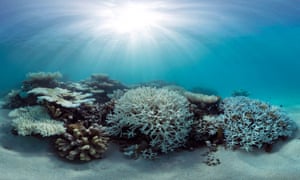
Coral bleaching in the Maldives during May 2016, captured by the XL Catlin Seaview Survey.
“France’s ratification is not only another indication of how seriously the international community takes the Paris agreement, but it also brings us another step closer to having it take effect,” he said. “Small island states were the first 14 countries to ratify the agreement and deposit their instruments of approval with the UN. We encourage all countries, large and small, to do the same.”
He added: “The faster we bring the climate agreement into force, the faster we can take the action required. And we have no time to waste.”
One of the key issues for the Maldives is the damage being done to coral reefs, an issue recently highlighted by a major Guardian investigation into the plight of the world’s most famous corals, the Great Barrier Reef in Australia. The Maldives have also experienced a high degree of coral bleaching, a sign of the death of reefs that comes from warming waters, pollutants and other environmental problems.
Source:

Thursday, October 13, 2011

Maldives could benefit from groundbreaking integrated climate change model


The Maldives, which is committed to becoming carbon neutral by 2020, could significantly benefit from a new branch of environmental science.

The Integrated Resource Model, which has been developed by Peter Head, of the Ecological Sequestration Trust, uses cloud computing to develop ecological models that boost economic growth and reduce carbon emissions.

Mr Head told delegates at the third annual Six Senses SLOW LIFE Symposium, that global computing power could be used to create a new development model for the Maldives.


He said: “Integrated resourcing covers energy, food, water and waste management. It is the concept that no single environmental problem can be solved in isolation.”

He added that the concept of sharing was vital in the fight against climate change. The most efficient use of finite resources, he explained, was sharing in a common cause.

Cloud computing is just one example of sharing – in this case computing processing power. Cloud computing is vital to his integrated resource modeling, which will be made available through open source on the “cloud”.

Mr Head also said that linking urban and rural development could boost overall agricultural output despite the loss of land for residential development.

“The analysis shows we can reduce carbon intensity but improve the ecological footprint as well,” he said.

He warned delegates that unless the pace of change towards a sustainable economy was accelerated, there would be a 50% chance of runaway climate change by 2070 that would lead to “total human catastrophe”.

Mr Head told delegates that he was seeking funding to enable the Maldives to take a global lead in Integrated Resource Modeling.

Other speakers during the last day of the SLOW LIFE Symposium included Sir Richard Branson, Eric Scotto of Akuo Energy and Jose Mariano, the founder of zero2infinity – the company which is planning on sending people into space using helium-filled balloons.

In the last session of the day, Sir Richard Branson said that business leaders had to do more to advance sustainable business development.

“If you are lucky enough to be a successful business leader – and you need a large element of good fortune – there is extreme responsibility that comes with that.

“If leaders are not responsible citizens and don’t redistribute that wealth then our current form of capitalism becomes questionable.

“Companies can become forces for good. The differences they can make locally and internationally is significant and the bottom line does not need to suffer for that to happen.”

Sonu Shivdasani, the Chief Executive of Six Senses, concluded the Symposium by saying that “sustainable business” had to become the norm and that the way in which business leaders were judged had to change to encourage companies to pay more attention to their environment.

“How we measure CEOs dictates how those CEOs behave.”
He added that the institutional owners of publicly listed companies should judge CEOs’ long term commitment to sustainability best practice and not just on short term profits.

Source: http://www.etravelblackboardasia.com

UN climate talks 'stupid and endless' - Maldives


The UN's talks on climate change are daft and crippled by finger-pointing and the need for consensus, the president of the Maldives, Mohamed Nasheed, was quoted on Thursday by Le Monde as saying.

Nasheed also said emerging economies were as much to blame for global warming as rich nations.

In an interview with the French daily, Nasheed pounded out the frustrations of vulnerable small island states with the 194-party UN Framework Convention on Climate Change (UNFCCC).

"The current negotiation process is stupid, useless and endless. It is based on this principle: two parties reach an agreement, a third one comes alone and says it doesn't agree and it reduces the ambition of the others," Nasheed said.

"In essence, even if we reach an agreement, it will be an agreement about nothing. It will be so diluted that it will be of no use," he said bitterly, calling for "an overhaul of international organizations."

Nasheed, whose comments were reported in French, was speaking during a visit to Paris.

He also criticized the rift in the UNFCCC talks over who was to blame for the man-made carbon emissions that stoke global warming.

Poor countries say rich countries bear "historical responsibility" as they were the first to burn the coal, gas and oil that cause the problem.

Rich countries say emerging giants such as China, India and Brazil also have to shoulder the burden as they have become huge carbon emitters in their own right.

"Responsibility is shared equally," said Nasheed.

"If the emerging countries had had the chance to emit as much carbon, they would have done the same, perhaps more so," he said.

"If the West stopped their emissions and China, South Africa and Brazil carried on emitting on the basis of business as usual, we would still die. The Maldives would disappear."

Efforts to tackle climate change were ravaged by the near-fiasco of the Copenhagen Summit of December 2009, where world leaders squabbled over targets and burden-sharing.

They cobbled together a last-ditch deal, the Copenhagen Accord, which sets down a voluntary approach of national pledges supported by financial pledges to help poor countries.

The UNFCCC's parties meet in Durban, South Africa, from November 28 to December 9 for their next annual conference. The big issue will be the future of the UNFCCC's Kyoto Protocol, whose current roster of promises expires at the end of 2012.

Global warming is predicted by scientists to have far-reaching impacts on the world's weather system.

It will also cause sea levels to rise, both through the thermal expansion of water and through the runoff of water from melted icesheets and glaciers.

Source: AFP

Tuesday, April 20, 2010


Forty-two-year-old President Mohamed Nasheed is the first democratically elected president in the island nation of the Maldives, home to 375,000 people located in the Indian Ocean off the tip of Sri Lanka. A former human rights activist and journalist, Nasheed was jailed and tortured by his predecessor. Today he is one of the most outspoken politicians in the world talking about the impact of climate change and its effect on all coastal areas, especially the low-lying Maldives.

Jon Bowermaster: How immediate is the problem of climate change and rising seas in the Maldives today? What evidence are you seeing?

President Nasheed: Climate change is not a distant or abstract phenomenon in the Maldives. The affects of climate change are being felt today. One-third of inhabited islands in the Maldives are suffering from coastal erosion, which is exacerbated by climate change. Fishermen are complaining that weather patterns have become unpredictable and warmer and more acidic seas threaten our coral reefs. If the world fails to curb carbon dioxide emissions and global temperatures continue to soar, these problems will worsen over the coming decades.

JB: Have sea levels risen already?

PN: The Environment Ministry calculates that sea levels in the Maldives are rising by 0.7 millimeters per year, which is around the global average. The big fear, however, is that this rise in sea level accelerates as climate change starts to rise even more towards the end of this century. This is a concern not just to the Maldives, but all low-lying areas around the world.

A 1-meter rise in sea levels, which some climate scientists warn will happen if nothing is done to reduce carbon pollution, would be devastating for the Maldives. Such a rise would also inundate other low-lying countries such as Bangladesh and the Netherlands and seriously threaten many of the world’s coastal cities. We must not allow this to happen.

JB: Soon after your election you announced plans to look for higher ground to move your people to. Where are you looking and how is the search going?

PN: Nobody in the Maldives wants to leave home. The government is doing everything we possibly can to remain here. We are improving sea defenses, such as sea walls, revetments and embankments. We are working to improve the coral reefs and coastal vegetation, which are our islands’ natural defense mechanisms. And we are exploring new building designs, such as building houses on stilts so they withstand storm surges and floods.

The bottom line, however, is dry land and if the world allows the climate crisis to turn into a catastrophe, then future generations of Maldivians will have no choice but to seek new homes on higher ground. I believe it is right to have this conversation today so we can start to plan for the problems tomorrow may bring.

Last year, I suggested we should start saving a portion of our tourism revenues in a Sovereign Wealth Fund, to help future generations cope with climate change. Ultimately, this fund could be used to help people leave.

If we ignore the warning signs and continue blindly down a ‘business as usual’ polluting path, then it will not just be Maldivians looking for a new home but also the good people of London, New York and Hong Kong.

JB: In your travels around the Maldives do you find that most people understand the seriousness of climate change and its potential impact on them?

PN: People living in Male’ and other urban areas are quite knowledgeable about the environment, particularly young people. In more remote parts of the country, people see that erosion is increasing. They know that the fish catch is more irregular and they understand that coral reefs are stressed. Maldivians know there are environment problems which affect their daily lives and that these problems are linked to global climate change.

JB: You’ve also proposed that the Maldives will become the first carbon neutral country in the planet. How is that going and have you set a timeline?

PN: We have a plan to make the Maldives carbon neutral in 10 years. At the heart of this plan lies a commitment to renewable energy. 155 1.5MW wind turbines, coupled with half a square kilometer of solar panels and a back-up biomass plant would produce enough green energy to power the country.

Aviation is trickier. Until airlines can switch to biofuels, there is little the Maldives can do other than offset the pollution caused by international tourist flights, by investing in carbon reduction schemes elsewhere.

Our carbon neutral plan is on track. This year, the government has started working with a number of international energy companies to build wind farms, which we hope will provide the bulk of our electricity. We are also working with the Government of Japan on a $10 million solar project, to install photovoltaic panels on schools and government buildings in and around the capital.

JB: You recently convened an underwater meeting of your entire cabinet. Whose idea was that? Some in the press called it a ‘stunt’—which is not always a bad thing, when you’re trying to draw attention to important issues.

PN: It was a cabinet decision to conduct the underwater meeting. We estimate that over 1 billion people watched, heard or read about the underwater cabinet meeting. While it was a bit of fun, it underscored a serious message. I hope the meeting raised people's awareness about the dangers climate change poses to the Maldives and the rest of the world. I hope that some of those people go on to ask their own politicians what they are doing to help solve the climate crisis. It is only when people start holding leaders to account, when politicians start losing elections over environmental issues, that they will treat climate change with the seriousness it deserves.

JB: What can bigger nations do to help lessen contributions to climate change, which will adversely impact island nations first?

PN: To save the Maldives—and the rest of the world—we need to halt climate change. It is as simple, and as complicated, as that. And to halt climate change, we must listen to the advice of those who know best. Not politicians, but climate scientists.

After the massive loss of polar ice two years ago, scientists realized that global warming was happening more quickly and on a larger scale than they had anticipated. Wherever scientists’ looked—high-altitude glaciers, hydrological cycles, and the spread of mosquitoes—they found change happening decades ahead of schedule. Average global temperatures have risen by about 2 degrees Fahrenheit since the Industrial Revolution but this has been enough to tilt the world's climate off balance.

In January 2008, James Hansen, one of the world's leading climatologists, published a series of papers showing that the safe limit for carbon dioxide in the atmosphere was at most 350 parts per million. Anything higher than that limit, warns Hansen, could seed "irreversible, catastrophic effects" on a global scale. At the moment, the amount of carbon dioxide in the atmosphere is 387 ppm and rising. Reducing the amount of carbon in the atmosphere to 350 is our best chance of preventing global temperatures from rising even further.

Sadly, most politicians have chosen to ignore these warnings and still talk about limiting temperature rises to 4 degrees Fahrenheit. But a 4-degree temperature rise would not stop climate change. Rather, 4 degrees will sink the Maldives, melt Greenland and devastate the Amazon rainforest. Four degrees would also turn most of the Mediterranean into desert. We must not allow that to happen.

We all need to stop polluting the atmosphere with greenhouse gases, which we know are poisoning our world. And we need to start using the renewable resources we all have in abundance to power the planet, namely, the sun, the sea and the wind.

JB: Many of the things causing climate change are created far from the shores of the Maldives. Do you hold the big industrial nations responsible for a problem now dramatically facing your country?

PM: Blaming others for causing the climate crisis is not necessarily the best way to solve it. What’s done is done. We want to focus on the future, not on the past. The industrialized nations have the greatest changes to make, in terms of transforming their economies towards carbon neutrality. But developing nations also have responsibilities.

If we want to reduce carbon pollution in the atmosphere, developing nations cannot pursue the same dirty development path that the West did. We must embrace renewable energy and green growth. Developing countries are relatively poor, however. To my mind, it makes sense that Western nations, that have the money and technical resources, should help poorer, developing nations go green. It is in everyone’s interest that richer countries play this leadership role, while also transforming their own economies.

JB: In the face of the growing consensus that our seas will rise, perhaps more quickly than we now expect, how do you maintain your apparent sense of optimism?

PN: I believe in humanity and human ingenuity. I do not believe that humans are suicidal or that the path ahead is insurmountable. I believe that the winners of the 21st century will be those countries that jettison dirty fossil fuels for renewable energy and green technologies. These pioneering countries will free themselves from the unpredictable price of foreign oil. They will corner the market in the green industries of the future. These countries will also have greater moral authority and political clout on the world stage.

The Maldives has committed to carbon neutrality but our efforts alone will not stop climate change. We need other nations to come on board and commit to carbon neutrality. Politicians rarely act unless their electorates push them to do so. In that regard, I would invite everyone living in a country that has not signed up to carbon neutrality to ask their elected representatives why they are dragging their feet on the most important issue in human history.

Source: http://www.takepart.com

Thursday, April 15, 2010

'We should avoid using climate for making new trade wars'

The European Union (EU) may have been hinting at imposing a carbon tax to force exporting countries into taking urgent steps towards adopting cleaner technologies, but EU’s Climate Action Commissioner says the carbon trade, or cap and trade, system is preferable to a carbon tax system. In New Delhi, Kirtika Suneja recently spoke to Connie Hedegaard about this cap and trade system and more. Edited excerpts:

Why do you prefer a carbon trade system to a carbon tax one?
In a carbon trade system, you put a price on carbon and set a cap on how much carbon can be emitted. There is also an incentive structure, so when emission permits are scarce, there is a price on them and those who are energy efficient, don’t need to buy those permits. In a carbon tax system, some countries might feel that because they are rich, they can pay the tax and others can do the reductions.


How do business houses react to such a system?

The business world gets to know that they can’t get as many permits as in the previous one, as the quota gets tightened. It forces them to innovate and find new smarter and intelligent energy-efficient solutions. Those who are energy-efficient, can be rewarded because they don’t need to buy energy allowances. All the 27 countries in Europe follow this system and business houses also did not mind it. We have set a target for 2020 and so, the businesses know the playing field till then.

What are the implications of levying a carbon tax on any country?
We should try to avoid using climate and environment for making new trade wars. We have to pursue an international framework to put a carbon trading system in place. We don’t have to put taxes on different goods to indirectly start a trade war. It is not difficult to start a trade war. That’s an easy solution and a last resort. Europe’s priority is a carbon trading system, a system of highest environmental integrity. I would not like to speculate into anything more.

You visited the Maldives before coming to India. What is the sentiment there?
The discussion at the Maldives revolved around sea rise. They are extremely vulnerable and already feel so. So, we should not talk only of the big players like the US, China or India, but also the smaller ones who are suffering and we can’t afford to wait for adaptation and financing mechanisms. They did not create the problem and should not be suffering the most.

What do you expect from the climate talks in Bonn?
The talks in Bonn are expected to start a process towards Cancun. These will be the first set of talks after Copenhagen, and I hope they are constructive. We need to get specific on decisions and actions, and start discussing the actual issues not just the procedures. Moreover, there will also be a ministerial level meeting in Bonn on May 2-3.

Source: http://www.business-standard.com

Wednesday, April 7, 2010

Tripartite MoU signed on, Trust for climate change adaptation and mitigation in Maldives

The Government of Maldives, the European Union (EU), and the World Bank Group today signed a tripartite Memorandum of Understanding , establishing a new Trust Fund designed to build resilience to climate change in the Maldives.

The EU has contributed EUR 6.5 million (approximately US$8.8 million) to the multi-donor Maldives Climate Change Trust Fund, which the World Bank will administer over a period of three and a half years. The majority of the Trust Fund resources will be utilized by the Government of Maldives to carry out their priority projects relating to climate change adaptation and mitigation.

"The Maldives has been a champion of climate change discussions and an important factor in Copenhagen, making a unilateral commitment to become carbon neutral by 2020," stated Mr. Bernard Savage, Ambassador of the European Union to Sri Lanka and the Maldives.

"Climate change is a serious global challenge, and a major threat to achieving the Millennium Development Goals by reversing development progress made in the last decade. It demands urgent, cooperative and shared responsibility to act. Thus the EU welcomes the opportunity to assist the Government of Maldives in reaching out towards their stated goals on carbon neutrality through this initial contribution of EUR 6.5 million."

A low lying archipelago with more territorial sea than land, the Maldives is exposed to the risks of intensifying weather events such as damage caused by inundation, extreme winds and flooding from storms. Sea level rise represents an existential threat to the country. With future sea levels projected to increase in the range of 10 to 100 centimeters by the year 2100, the entire country could be submerged in the worst-case scenario.

Threatened with its very existence, the Government of Maldives has declared its intention to fight climate change over the next decade, including a vision to cut carbon emissions to become a carbon neutral nation.

It’s crucial for Maldives to build a climate resilient economy and society through adaptation, said Naoko Ishii, World Bank Country Director for Sri Lanka and the Maldives.

The commitment and manner in which Maldives addresses the environmental challenges and builds a climate-friendly economy will not only have important demonstration effects for the country, but also the world.

The development objectives of the Trust Fund Program are to:

• Strengthen knowledge and leadership in the Government of Maldives to deal with climate change issues both domestically and internationally;

• Build adaptive capacity and climate resilience in key sectors through tangible pilot interventions;

• Promote energy efficiency and increase energy access through renewable energy generation and distribution through low carbon options and public-private partnerships; and

• Improve policy and institutional capacities in the public and private sectors to deal with adaptation and mitigation interventions that bring both developmental and climate change benefits.

The governance arrangements for the Program include a Climate Change Advisory Council in the Office of the President with representatives from the government to provide strategic direction to the climate change activities under the Trust Fund. In addition, a Technical Committee composed of technical experts of the Government of Maldives, private sector and leading civil society organizations is responsible for reviewing and recommending technically well-sound project proposals for financing and monitoring the overall progress of the program.

The Maldives stands at the frontline of the climate change battle. We are one of the most vulnerable countries on Earth and therefore need to adapt to climate change, said Dr. Mohammed Waheed Hassan, Honorable Vice President of Maldives. No amount of adaptation will save the Maldives if the world continues to burn carbon. We are therefore aiming for carbon neutrality, to show the world that you dont need to burn carbon to develop.

The interventions paid for from the trust fund are expected to be on strengthening ongoing efforts in areas such as coastal protection, biodiversity conservation, tourism, fisheries, livelihoods and water options, solid waste management, and energy solutions.

This multi-donor trust fund provides a significant opportunity for interested donors to support Maldives in addressing the climate challenges in a coordinated manner, said Priti Kumar, Senior Environment Specialist and World Banks Team Leader for the Trust Fund.

Source: http://www.asiantribune.com

Tuesday, March 30, 2010

President supports Guin Batten’s attempt to cross the Zero Degree Channel solo

President Mohamed Nasheed has extended his support for Olympic rower Guin Batten’s attempt to cross the Zero Degree Channel (Addoo Kandu) in the Maldives solo.

Ms Batten began her attempt in a standard coastal rowing boat to be the first person to cross the 60 kilometre wide Zero Degree Channel solo in a rowing boat, today. She will make the cross using a standard coastal single sculling boat that is 6 metres long, 78 centimetres wide and weighs 35 kilograms. She is expected to complete feat on 2 April.

Objectives of the crossing include raising international awareness of the threat of climate change on the Maldives, and supporting and increasing the profile of rowing especially women’s rowing in the Maldives.

Wishing Ms Batten success in her crossing, President Nasheed said this attempt in the Maldives by a world renowned athlete from a friendly country was a glaring example of the Ms Batten’s and the international community’s support for the development of women of this country.

Guin Batten won an Olympic silver medal at the Sydney Olympic Games in 2000. In 2003 she also broke the world record for crossing the English Channel.

Source: http://www.presidencymaldives.gov.mv

Saturday, November 28, 2009

Nepal cabinet to meet near Everest to highlight climate change

Nepal's cabinet will meet near the base of Mount Everest next week to highlight the impact of climate change on the Himalayas, ahead of the UN summit to discuss global warming in Copenhagen, officials said today.

About 26 ministers and other cabinet officials will fly to Gorakshep on a helicopter to attend the cabinet meet scheduled to take place on December 4 at an altitude 5,165 metre near the Everest base camp, said Bishnu Rijal, the prime minister’s press advisor.

He said the cabinet meeting at the gateway to the Everest will pass a resolution on climate change.

A medical team will accompany the government officials along with oxygen cylinders to facilitate the cabinet meeting, he said.

The unique meeting comes after the Maldives Cabinet met underwater in October to symbolically flag the threat of global warming ahead of a crucial UN Summit.

The government of the Maldives had held the underwater cabinet meeting in a bid to draw global attention towards the rising sea levels that threaten the existence of the island country.

Earlier, mrime minister Madhav Kumar Nepal underlined the adverse impact of climate change on his country. He said Nepal is the most affected by the melting snows and our melting glaciers are inviting a bigger catastrophe in near future though it contributes minimum to the global climate change. Prime minister Nepal said his country will raise the issue of global warning in a big way at the Copenhagen conference in Denmark from December 7-18.

The Nepalese cabinet meeting, which had earlier been planned at an altitude of 5,360 metres in November, was postponed due to the ill health of the prime minister. The officials also visualised logistic problem in holding the meet at an higher altitude.

The landmark cabinet meeting would provide an unique opportunity for the top Nepalese leaders to have a first-hand information about the adverse impact of climate change on the Himalayan range, the PMO official said.

According to experts, glaciers are melting at an alarming rate, creating lakes whose walls could burst and flood villages below.

Source: dnaindia.com

Saturday, September 26, 2009

Maldives urges UN Member States to take critical action to combat climate change


The President of the Maldives implored world leaders gathered at the United Nations to urgently help the group of islands he governs in the middle of the Indian Ocean fight the menace of global warming, in a message to the General Assembly today.

“The threats posed to the Maldives from climate change are well-known,” President Mohamed Nasheed told the second day of the Assembly’s annual high-level debate at UN Headquarters in New York.

As beaches are lost to rising seas, houses to storm surges, jobs as fish stocks dwindle, and lives lost to more frequent extreme weather events, the scattering of islands becomes harder and harder to govern “until a point is reached when we must consider abandoning our homeland,” said Mr. Nasheed.

Calling on world leaders “to protect the future of front-line countries like the Maldives,” he said an ambitious new treaty on greenhouse gas reductions must be reached at December’s UN climate change conference in Copenhagen, which seeks to limit average global temperature increases to less than 1.5 degrees centigrade above pre-industrial levels.

“To do otherwise would be to sign the death warrant for the 300,000 Maldivians,” stressed Mr. Nasheed.

“But, the Maldives is determined to do what we can to survive,” he said referring to the archipelago’s commitment to be the first carbon-neutral country in 10 years time.

“In order to do that, we are determined to formulate a survival-kit, a carbon-neutral manual that would enable others to replicate in order that all of us together might just about save ourselves from climate catastrophe.”

Mr. Nasheed also hoped to invite some of the States most affected by climate change to the Maldives this November to “reinforce our determination to leave no stone unturned to ensure our survival.”

In addition, he said that the nascent democracy, which held its first ever multi-party presidential elections last year needed help from Member States in consolidating democracy and establishing a secure, prosperous and equitable society for the country.

Mr. Nasheed said he was thankful to be the first democratically-elected President of the Maldives to attend the General Assembly debate, many of which in the past he had spent bound up in a cell for his beliefs about freedom.

Source: un.org

Wednesday, September 23, 2009

We are sinking, say Maldive islanders, but there is still time to save the world

The President of the Maldives, the Indian Ocean islands threatened with extinction by rising sea levels, told the United Nations climate-change summit yesterday that the country’s appeals for help had fallen on deaf ears for 20 years.

“Once or twice a year we are invited to attend an important climate change event such as this one — often as a keynote speaker,” Mohammed Nasheed told world leaders at the UN headquarters in New York.

“On cue, we stand here and tell you just how bad things are. We warn you that unless you act quickly and decisively, our homeland and others like it will disappear before the rising sea, before the end of this century.

“We in the Maldives desperately want to believe that one day our words will have an effect, and so we continue to shout them even though, deep down, we know that you are not really listening,” he said.

Mr Nasheed had again been invited to address a UN climate summit, in the approach to the Copenhagen conference this December at which world leaders hope to “seal the deal” on reducing gas emissions. His speech was sandwiched between those by the two leaders best equipped to save his island nation: President Hu of China and President Obama of the US, representing world’s No 1 and No 2 greenhouse gas emitters respectively.

But Mr Nasheed argued that developing nations must be ready to accept binding targets even if rich countries do not act. “We ask world leaders to discard those habits that have led to 20 years of complacency and broken promises on climate change, and instead seize the historic opportunity that sits at the end of the road to Copenhagen,” he said.

Ban Ki Moon, the UN Secretary-General, said: “Success in Copenhagen will have positive ripple effects for global co-operation on trade, energy, security and health. Failure to reach broad agreement would be morally inexcusable, economically shortsighted and politically unwise.”

Rajendra Pachauri, chairman of the Intergovernmental Panel on Climate Change, said that without counter-measures global temperatures would rise by up to 6.4C by 2100. The dangers include the disappearance of sea ice and more frequent cyclones, heat waves and heavy rains. Water would become scarce in semi-arid areas such as the western US, the Mediterranean Basin, Southern Africa and northeastern Brazil. The Greenland ice sheet might also disappear, leading to a seven metre (23ft) rise in sea level.

“The impacts would be disproportionately severe on some of the poorest communities of the world,” Mr Pachauri said. “At least 12 countries are likely to tend towards becoming failed states and communities in other states would show potential for serious conflict due to scarcity of food, water, stress and soil degradation.”

Mr Pachauri called for steps to ensure that global emissions peaked no later than 2015.

Among the most far-reaching pledges from developed nations, Japan’s new Prime Minister, Yukio Hatoyama, to reduce the emissions to a level 25 per cent below the 1990 level by 2020; the previous Japanese Government’s target was 8 per cent. That move, combined with the Chinese offer to slow its emissions, and a recent offer by India to set numerical targets for cutting its greenhouse gas emissions, added to pressure on President Obama to act. too.

Al Gore, the former Vice-President, said that he hoped that the US Senate would pass climate change legislation by December, as the House of Representatives had done, so that Mr Obama would be able to make a firm offer.

However, activists criticised Mr Obama’s speech, in which he offered little except a recognition that the US had a duty to play a leading role.

Asad Rehman, of Friends of the Earth, said: “Barack Obama’s speech was deeply disappointing — it was a huge missed opportunity which does nothing to break the logjam in international climate negotiations.”

James Cameron, of Climate Change Capital, said of the Chinese initiative: “The Chinese move will help create the world’s largest market for the technology and the knowhow needed to combat climate change, which represents great business opportunities that have a public good at their core. China is moving rapidly to create the incentives for low-carbon investments.”

Gordon Brown arrived in New York last night and was seeking support from advanced nations to back a $100 billion fund to support developing nations as they switch to green technologies. Britain is committed to a European Union target to reduce its carbon emissions by 20 per cent from 1990 levels by 2020.

A British official described the proposal by President Hu of China as “definitely encouraging”.

“We obviously need to see numbers from China but we need to see numbers from everybody before December,” the official said.

Source: timesonline.co.uk

Time grows short for climate deal

The man from the middle of the Indian Ocean, from one of the tiniest of nations, told his fellow presidents he knew "you are not really listening."

But a desperate Mohammed Nasheed of the Maldives, a scattering of islands amid the rising seas of global warming, took to the podium nonetheless at Tuesday's U.N. climate summit to urge his global neighbors, after "20 years of complacency," to "seize the historic opportunity that sits at the end of the road to Copenhagen."

That opportunity in Copenhagen, at a pivotal negotiating conference this December, is a chance to forge a comprehensive new accord to combat climate change. But increasingly Nasheed's road seems likely to stretch beyond the Danish capital, and beyond 2009, as world governments grapple with this immensely complex and volatile issue.

Some 100 heads of state and government took part in the one-day summit, the largest ever to deal with global warming.

They heard from Nasheed and leaders of other states threatened with flooding, drought and other expected impacts of a warming world. "If things go as usual, we will not live. We will die," the Maldivian said of his low-lying islands, a nation of 300,000 people.

Summit participants heard, too, from U.S. President Barack Obama and leaders of other industrialized nations, who spoke of their determination to take new steps to halt climate change.

But with a mere 76 days to go before the Copenhagen meeting, it appeared an interim agreement might be the most that can be expected this December, leaving difficult details for later talks.

Tuesday's gathering was the latest effort in a long, cumbersome process dating back to the Earth Summit in Rio de Janeiro in 1992, when national leaders signed on to something unprecedented, a treaty committing them to work "to protect the climate system for present and future generations."

Scientists had produced persuasive evidence that the carbon dioxide, methane and other greenhouse gases that industry, transport and farming were pouring into the atmosphere were trapping heat and raising global temperatures, with potentially damaging effects from a changing climate.

Five years after Rio, negotiators added the Kyoto Protocol to the treaty, with its first, modest reductions in emissions by industrialized countries. The U.S. Senate repudiated the pact, however, and the process entered an eight-year slowdown as the U.S. administration of President George W. Bush resisted global pressure for deeper concerted action.

The U.S. opponents complained emissions reductions would crimp the American economy, and objected to Kyoto's excusing of China, India and other poorer countries from having to reduce their energy use.

As the diplomacy decelerated, climate change accelerated.

Average global temperatures had risen 0.74 degrees C (1 degree F) over the past century. The pace of sea-level rise, from heat expansion and melting land ice, increased in the late 20th century. And just last week, scientists reported that one of recorded history's greatest losses of Arctic sea ice to summer melt occurred this year. Scientific forecasts are growing ever more bleak.

While waiting for change in Washington, diplomats in 2007 set a two-year timetable for replacing the Kyoto pact, which expires in 2012, aiming at a new overall deal at the annual U.N. climate conference this December. The election of Obama, who pledged U.S. action, put new life in the process. But time was working against that timetable.

The House of Representatives in June did pass the first U.S. legislation to cap carbon emissions. The Senate, however, embroiled in the U.S. health care debate, delayed addressing the issue. Without U.S. domestic action, the rest of the world isn't likely to commit to an overall, detailed post-Kyoto accord.

Instead, it appeared increasingly that Copenhagen, at best, may produce a framework for further talks, while pieces fall into place in Washington and elsewhere, and Kyoto's formulas are perhaps extended.

Such a Copenhagen plan might set an aggregate goal for emissions reductions by richer countries, with 2020 and 2050 targets, and envision "policy-based" commitments by China and other developing countries — for example, not reducing emissions directly, but reducing "carbon intensity," or fossil-fuel use per unit of economic growth.

Depending on how well the world is rebounding from the current economic slump, richer nations might also declare their readiness to boost financial support for developing countries to switch to clean energy technologies, and to adapt to climate change's impact on their crops, their shorelines and their economic lives.

At Tuesday's summit and earlier, China, India, Brazil and other developing nations indicated they're prepared to take such steps. The Europeans and Japan's new government, meanwhile, say they'll deepen their emissions cuts. And the Americans, 17 years after Rio, may be prepared to adopt their own reductions.

But December looks too close, and the issues look too complex, for it all to mesh into a single sweeping deal in Copenhagen.

Tuesday's summit was a "step in the right direction," said Danish Prime Minister Lars Loekke Rasmussen, who will host the world in December. "And yet we are still far from a solution."

Source: CHARLES J. HANLEY (AP)
Tuesday, September 22, 2009

Climate Week In New York–U.S. Must Catch Up To The International Community

New York City gears up for a busy week on climate, poverty, health pandemics, nuclear disarmament and conflict and peace negotiations. Over 100 world leaders from Russia, China, India, Iran and other developed and developing nations will gather at the UN’s Climate Summit and General Assembly, the Clinton Global Initiative and other smaller forums organized throughout the city. The climate debate is at the top of the agenda and industrialized leaders will travel to Pittsburgh at the end of the week where the G-20 will gather to discuss a plan to combat global warming ahead of a major international climate conference in Copenhagen in December.

Making your way through town, one can feel a buzz in the air–anti-Ahmadinejad and Qaddafi protests are rampant, as are tabloid papers masking themselves as the New York Post with headlines “We’re Screwed. What you’re not being told: Official City report predicts massive climate catastrophes, public health disasters.”

To add to the inflamed excitement, Mayor Mike Bloomberg, a lead organizer of Climate Week NY failed to show up at his city’s climate opening ceremony. But other notables took the reign including former United Kingdom Prime Minister Tony Blair who’s climate group launched a report today entitled”Breaking the Climate Deadlock: Cutting the Cost.”

The report outlines the economic benefits for countries that go green and reduce carbon emissions. The findings indicate that if a deal is reached at the global Copenhagen climate conference in December, cutting emissions could potentially create as many as 10 million new jobs in 2020 and thus generate additional economic growth via the adoption of low carbon technologies that accelerate sustainable development in developing countries.

“This is more difficult that all the negotiations where I have been involved including the Middle East peace process and NATO,” Blair added. “However, there is a way — we must distinguish short term and long term targets. 2020 is a long way ahead. The enormous cost savings that can be achieved if countries act together are striking.”

CEO of the Climate Group, Steve Howard, summarized: “Climate Week is a partnership to see how we can come up with a successful deal in Copenhagen–but there is a lot of lifting to be done.”

United Nations Secretary-General Ban Ki Moon, said he wanted to ask Mayor Bloomberg to begin calling New York the “Big Green Apple.”

Celebrity actor Hugh Jackman also joined the opening ceremony and shared his “going green” experiences based on a recent trip to Ethiopia. Todd Stern, United States Special Envoy for Climate Change and the Administrator’s chief negotiator said he was hopeful Obama would go to Copenhagen with or without a Senate approved climate bill.

Representatives from China and India also commemorated the day–both recently lauded for implementing effective national plans to boost green energy. The word is also out that China plans to unveil an ambitious energy conservation plan tomorrow at the UN Climate Summit. According to Yves de Boer, Executive Secretary of the United Nations Framework Convention on Climate Change (UNFCCC), who met with reporters earlier this morning, “Everyone knows about the one or two power plants China opens up every week, but nobody knows that China is also closing one or two power plants every week as well.” De Boer added “China doesn’t need anybody’s money, but they want to cooperate on clean technology.”

Nevertheless, de Boer believes “Obama is doing his darndest. But the international community is saying, what is the United States doing in all of this? Why has the protocol son not joined the international community?”

Many international skeptics have criticized the United States for being the world’s biggest polluter per capita, and at the same time, being slow to approve the Markey-Waxman bill and other climate change initiatives –when other countries have sped far ahead on this agenda.

Across town, at the Natural History Museum in New York’s Upper West Side, the Alliance of Small Island States (AOSIS) including Cape Verde, Grenada, Nauru, Maldives and Trinidad, got together to talk about the “murder” being committed by industrialized nations on small islands. Lead organizer, President Mohamed Nasheed of the Maldives said “Climate Change is already delivering damage not of our making. Should we, leaders of the most vulnerable and exposed countries, be asking our people to sign onto significantly greater degrees of misery and livelihood insecurity, essentially becoming climate change guinea pigs?”

AOSIS is calling on industrialized nations to demand a global warming limit in Copenhagen and to cut emissions by 45% by 2020. The Alliance group is also asking for global temperature increases to be well below 1.5 degrees C in order to ensure the survival of small and low lying islands and their inhabitants. Many smaller islands are disappearing leaving residents homeless due to rising water levels caused by melting polar ice caps and global warming.

Source: talkradionews.com

Thursday, August 20, 2009

Budget cut to keep Maldives away from U.N. climate talks


The Maldives on Wednesday said a budget crisis will keep its president from attending landmark U.N. climate talks, the results of which could have a huge effect on the future of the low-lying archipelago.

Famed mostly for its high-end luxury resorts and white-sand atolls, the Maldives has also made a name for itself as an advocate for mitigating climate change -- because rising sea levels are forecast to submerge most of its islands by 2100.

President Mohamed Nasheed has canceled his trip to the talks in Copenhagen in December as a measure to cut government expenditure and reduce a yawning budget deficit worsened by low tourist numbers during the global downturn.

"We will engage with Copenhagen as much as possible without the president traveling there," presidential spokesman Mohamed Zuhair said.

The Maldives' $850 million economy, based almost entirely on fishing and tourism, saw its budget deficit nearly triple to 14 percent of GDP last year, due to substantial increase in government spending, figures from the Maldives Monetary Authority showed.

The global downturn has also cut into tourist arrivals.

Nasheed drew global attention shortly after his election last year when he said the Maldives would start looking to buy land in other countries to resettle people once the seas rose, but later acknowledged it was not financially feasible.

This year, Nasheed said the Indian Ocean islands would swap fossil fuels for wind and solar power over the next decade, and buy and destroy EU carbon credits to offset emissions from tourists flying in to visit its luxury vacation resorts.

In 2007, a U.N. climate change panel predicted an increase in sea levels of 58 cm, which would submerge many of the Maldives' 1,192 islands by 2100.

U.N. scientists have warned global warming caused by high atmospheric levels of carbon dioxide (CO2) will lead to rising seas, big storms, mass heatwaves and droughts.

The current climate pact, the Kyoto Protocol, expires in 2012 and countries are scrambling to negotiate a follow-up deal that many hope will include the United States and commit developing nations such as China and India to cut greenhouse gases.

Negotiators in Bali agreed to start two years of talks to be concluded with the signing of a new treaty at the U.N.'s 2009 climate talks in Copenhagen, Denmark.

Nasheed last year unseated Asia's longest-serving ruler, 30-year incumbent President Maumoon Abdul Gayoom, in the islands' first multi-party presidential election. Gayoom has become a vocal advocate for mitigating climate change.

Source: in.reuters.com

Saturday, February 28, 2009

U.N. Says Climate Change Threatens Right To Housing In Maldives

Rising sea levels and coastal erosion, both wrought by climate change, threaten the viability of Maldives, a United Nations independent expert cautioned Thursday.

The UN expert also said that overcrowding and other impacts are already felt by the island nation's 300,000 people.

After an eight-day visit to the country, Raquel Rolnik, Special Rapporteur on adequate housing, said that "Maldives and its Atolls, because of their unique geological and topographic aspects and their fragile and delicate environmental system, are already experiencing the impacts of climate change."

This jeopardizes the survival of the nation, which could be inundated by water, but more immediately, it jeopardizes the right to housing due to the scarcity of land, a UN press statement said.

Over the past four years, donors and agencies have mobilized over $400 million in aid, but the Rapporteur voiced concern over the allocation of the resources and their management by Maldivian authorities.

Over 80,000 migrants from Bangladesh and other South Asian countries live in Maldives, with half of them working in the construction sector, and the Rapporteur said she was concerned over their housing and living conditions.

She called for a "human rights-based approach" to address the housing situation in the country, calling for the government and international organizations to promote public participation in making key decisions.

Source: allheadlinenews.com

Sunday, December 14, 2008

Poor accuse rich of meanness in U.N. climate fight

Developing nations accused the rich of meanness on Saturday at the end of U.N. climate talks that launched only a tiny fund to help poor countries cope with droughts, floods and rising seas.

They said agreement on the Adaptation Fund -- worth just $80 million -- was a bad omen at the halfway mark in two years of negotiations towards a new treaty designed to be agreed in Copenhagen at the end of 2009 to fight global warming.

"We are so sad and so disappointed," Colombian Environment Minister Juan Lozano said of the Dec. 1-12 talks, which went on into the early hours of Saturday.

"The human side of climate change is the suffering of our orphans and our victims and that was not considered here. It's a bad signal on the road to Copenhagen," he said.

"I must say that this is one of the saddest moments I have witnessed in all these years," Indian representative Prodipto Ghosh told delegates at the 189-nation talks, adding he had attended U.N. meetings for 12 years.

"In the face of the unbearable human tragedy that we in the developing countries see unfolding every day this is nothing but callousness, strategising," he said. Several other nations including Brazil, Costa Rica and Maldives made similar remarks.

Many delegates expressed hopes that U.S. President-elect Barack Obama would adopt more aggresive climate policies.

Environment ministers at the talks in Poland set rules for the Adaptation Fund, which is meant to help poor nations build flood defences, develop drought-resistant crops, and produce storm warnings.

The fund, among few points agreed at the meeting, has just $80 million but could rise to $300 million a year by 2012. The developing nations accused the rich of blocking talks on wider funding. The issue was delayed until 2009.

COSTLY CONFERENCE

U.N. projections are that poor nations will need tens of billions of dollars a year by 2030 to cope with climate change. Poland spent 24 million euros ($31.84 million) just to host the Dec. 1-12 conference.

"It is obvious that the existing amount of money for the Adapation Fund ... is much too low," said German Environment Minister Sigmar Gabriel.

Developing nations won streamlined access to funds while rich nations secured controls to ensure cash was properly spent.

Overshadowed by worries about a global recession, the main task of the meeting was to review progress towards a sweeping new global climate treaty in Copenhagen in December 2009 to replace the Kyoto Protocol.

"We are desperately disappointed with the progress here," said Stephanie Tunmore of the Greenpeace environmental group. "The stocktaking bit wasn't difficult: 'What did we do in 2008? Not much'."

Environmentalists accused Australia, Canada, Japan and New Zealand of blocking progress and failing to set ambitious new goals to cut emissions. By contrast, countries including Mexico, China and South Africa laid out ideas to curb rising emissions.

European Environment Commissioner Stavros Dimas said the talks were on track.

"Everyone said the fight against climate change is consistent with tackling the economic crisis," he said. Many delegates said stimulus packages to end the global economic crisis could help create millions of green jobs.

European Union ministers in Poznan expressed relief after EU leaders in Brussels agreed a pact on Friday to cut greenhouse gases by 20 percent below 1990 levels by 2020 -- after making costly concessions to east European countries.

The U.N. Climate Change Secretariat said the talks achieved the main goals of agreeing a plan of work towards Copenhagen.

Under the Adaptation Fund, cash is raised by a 2 percent levy on a U.N. system of projects to cut greenhouse gas emissions in poor nations. The levy has raised 60 million euros ($80 million) so far.

Negotiators also agreed measures to speed up approval of projects such as cutting greenhouse gases from factories in China or building windmills in Morocco.

Source: Reuters