Showing posts with label Mohamed Nasheed. Show all posts

Saturday, July 25, 2015

Maldives prosecutor general to appeal against ex-president's conviction

Decision based on Mohamed Nasheed’s complaint of procedural irregularities in his trial on terrorism charges.
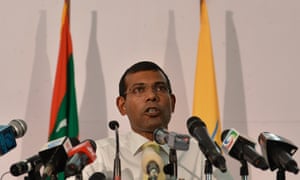
Former president of the Maldives Mohamed Nasheed speaks to the press, November 2013

The Maldives’ prosecutor general has said he will appeal against the conviction of former president and opposition leader Mohamed Nasheed, who was jailed for 13 years in March after a trial the UN described as “vastly unfair”.

A statement released by the prosecutor general’s office said the decision was based on Nasheed’s complaint of procedural irregularities in his trial, including “the violation of some fundamental rights and inadequate time to prepare his defence”.

“The prosecutor general of the Maldives has decided to appeal the case of former president Mohamed Nasheed,” it said.

The president, Abdulla Yameen, has faced a chorus of international criticism over the jailing of Nasheed, the first democratically elected leader of the archipelago, on charges of terrorism.

Nasheed’s lawyers resigned before the end of his brief trial, saying it was biased and aimed at destroying his political career.

It came at a time of growing opposition to Yameen’s government and was expected to prevent Nasheed from running for president in elections in 2018.

The US secretary of state, John Kerry, warned in May that democracy in the Maldives was under threat, saying Nasheed had been “imprisoned without due process”, and urging a rethink.

An international team of lawyers, including London-based human rights lawyer Amal Clooney, has petitioned the United Nations over Nasheed’s controversial jailing.

Nasheed, a climate change activist who was imprisoned during the three-decade rule of former strongman Maumoon Abdul Gayoom, became the country’s first democratically elected leader in 2008. He was toppled in February 2012 after a mutiny by police and troops that followed weeks of protests over the arrest of a top judge who had been appointed by Gayoom.

Nasheed had ordered the arrest, and it formed the centrepiece of his prosecution.

Yameen, the half-brother of Gayoom, controversially beat Nasheed in an election runoff in late 2013 despite trailing in the first round.

The Nasheed controversy has dealt a further blow to the image of the Maldives as an upmarket tourist destination, already marred by political unrest on the streets of the capital since he lost power in 2012.

In May Nasheed’s lawyer filed a petition with the UN arguing his detention was illegal and a violation of international law. His wife Laila Ali also visited Washington to lobby the White House, State Department and Congress over his detention.

The Maldives government had always insisted he had received a fair trial. But last month, Nasheed was moved out of his prison cell and confined to house arrest while he received medical treatment, in what some saw as a possible sign of softening towards him.

Friday, July 24, 2015

Maldives foreign land ownership reform bill is approved


Maldives President Abdulla Yameen has approved a law passed by parliament on Wednesday which allows foreigners to own land for the first time.


Up until now the constitution prohibited foreign ownership of any part of Maldivian territory.

But now foreigners will be allowed to buy land provided they invest more than $1bn and provided that 70% of it is reclaimed from the Indian Ocean.

Critics fear the move could enable China to set up bases in the Maldives.

The government has denied this, saying it wants foreign investment on a commercial basis.

It says that foreign investors will be able to buy 10% of the 298 square km (115 square miles) of naturally occurring land that make up the the Maldives.


It hopes that the move will attract offshore investors into special economic zones set up by President Yameen to make the economy less reliant on tourism.

But opposition MPs fear that the measure could enable China to establish bases in the strategically important Islamic republic, which lies within important international east-west shipping routes.

Correspondents say that any Chinese move into the Maldives is certain to be viewed suspiciously by India, which considers the Maldives archipelago to be within its sphere of influence.

"We can't ignore the fact there is a cold war brewing between India and China," Opposition Maldivian Democratic Party MP Eva Abdulla told the AFP news agency.

But Vice President Ahmed Adeeb rejected concern over the move, pointing out that it had been done to generate foreign investment.

"We are not going to sell land to other countries, whether it's China or Saudi Arabia," he was quoted as saying by Minivan News on Thursday.

The Maldives comprises thousands of tiny coral islands located across the equator.

It has endured considerable political unrest since its first democratically elected president, Mohamed Nasheed, was overthrown in a coup in February 2012.

There have been frequent street protests in the capital Male since Mr Nasheed was convicted earlier this year on terrorism charges.
Source: http://www.bbc.com/news/world-asia-33638516

Maldives law 'selling' foreigners islands stokes Delhi's fears of rising Chinese role

With anyone investing $1bn now able to own land in perpetuity, concerns are growing that the Maldives will become the focus of an Indian Ocean cold war


A new law allowing foreigners to own land on the Maldives, the island nation known for luxury tourism, has sharpened regional competition for influence over one of the busiest oceans in the world.
On Thursday Abdulla Yameen, the controversial president of the Maldives, approved a law allowing foreign ownership of land in the country for the first time, triggering concern in Delhi over a possible opportunity for China to extend its reach in the Indian Ocean region.
Dozens of foreign companies already run luxury resorts on islands that they lease from the government of the honeymoon islands for a maximum of 99 years.
The law would allow foreigners who invest more than $1bn (£650m) to own land in perpetuity, provided 70% of it is reclaimed from the sea.
India has watched warily as the Maldives, which held its first free elections in 2008 after more than three decades of autocratic rule, has tilted towards China in recent years.
The two emerging Asian powers are battling for influence in the region, with Delhi concerned at what it sees as aggressive moves by Beijing in what it considers its backyard.
India won the most recent round of manoeuvring when President Mahinda Rajapaksa of Sri Lanka was ousted in a surprise defeat in January. Rajapaksa had increasingly looked to China for investment and diplomatic support. The new Sri Lankan president, Maithripala Sirisena, has shifted Sri Lanka’s policy back towards Delhi.
The Maldives have also seen competition. An Indian company had a major contract to extend the existing airport cancelled, while the Chinese are helping to build a crucial $300m road link between the airport and the capital, Malé. India was also closer to the former president and current opposition leader Mohammed Nasheed, who was ousted in 2012 and is currently under house arrest.
Yameen went out of his way to reassure India in an address to the nation. “The Maldivian government has given assurances to the Indian government and our neighbouring countries as well to keep the Indian Ocean a demilitarised zone,” the president was quoted as saying by the local Minivan News website.
Yameen said the foreign policy of the Maldives would not change and the new move would not pose “any danger to either the Maldivian people or our neighbouring countries”.
Officials in Delhi said they were examining Yameen’s statements closely.
Lawmakers in the Maldives voted on Wednesday for the bill, which easily passed after a brief debate, with 70 members in favour and 14 against, the assembly said in a statement.
But opposition MPs expressed fears that their small nation, made up of about 1,200 tiny islands, would be caught in the “a cold war brewing between India and China”.
Since Nasheed was jailed for 13 years in March there have been regular protests on Malé’s streets.
Loyalists have argued that the detention of the human rights activist turned politician is an attempt to shut down opposition to the government of Yameen.
David Cameron called last month for “political dialogue [and the] release of Nasheed and all political prisoners” in the Maldives.
The Maldivian prosecutor general said on Friday that he would appeal against Nasheed’s conviction.

Source: http://www.theguardian.com/world/2015/jul/24/maldives-law-selling-foreigners-islands-stokes-delhis-fears-rising-chinese-role 
The government in the Maldives has decided to commute a prison term handed down to former President Mohamed Nasheed to time under house arrest.

The Maldivian government, which has been facing mounting international pressure over the conviction of Nasheed, had already moved him from prison and placed him under house arrest.

On Friday, however, his international lawyer, Jared Genser, confirmed that Nasheed’s 13-year prison sentence has been commuted to a term under house arrest.


“The government of the Maldives has permanently moved President Nasheed to house arrest for the balance of his 13-year term in prison,” Genser told reporters in the capital of Sri Lanka, Colombo.

Earlier on Friday, the government also announced, “The prosecutor-general of the Maldives has decided to appeal the case of former President Mohamed Nasheed.”

Nasheed, who was sentenced to 13 years in March, has complained to the United Nations about “the violation of some fundamental rights” in his trial, adding that his lawyers had “inadequate time to prepare his defense.”

He was arrested under the Anti-Terrorism Act and charged for authorizing the detention of Criminal Court Judge Abdulla Mohamed in 2012, when he was the country’s president.

Fair or unfair?

In May, the United Nations Human Rights Office assessed the trial of Nasheed as “vastly unfair” after a UN delegation to the Maldives found the conviction of the former president to be biased.

 Mona Rishmawi, who headed the mission to the Maldives, said Nasheed’s trial had been “politically biased, inadequate and subject to external influence.”

However, the Maldivian government says the former president had received a fair trial.

Nasheed was the first democratically-elected president of the Maldives from 2008 to 2012.
Source: http://www.presstv.ir/Detail/2015/07/24/421661/Maldives-Mohamed-Nasheed-house-arrest

Maldives commutes ex-president’s 13 year term to house arrest

Former Maldivian president Mohamed Nasheed's 13 years of jail term has been commuted to house arrest, media reported. Ex-president was sentenced for 13-year prison after he was found guilty of ordering the arrest of a judge while in office.

Maldives commutes ex-prez’s term

"The government of the Maldives has permanently moved president Nasheed to house arrest for the balance of his 13- year term in prison", his international lawyer Jared Genser said. The lawyer's comments came hours after the Maldives government said it would appeal against Nasheed's conviction in March which drew heavy international criticism.

A spokesman for the Maldivian High Commission in Colombo confirmed the changes to Nasheed's sentence, but said he had no further details. "It is correct that the jail term is now commuted to house arrest," Hussain Mazin told AFP.

Indian Ocean games

Delhi must stop complaining and start thinking of how to repair strained ties with the Maldives

New Delhi is predictably upset with the Maldives for an amendment to the country’s constitution permitting foreigners to own land, provided the entity invests a minimum of $1 billion. The move is being seen as an attempt by the Indian Ocean atoll to forge closer ties with China. Chinese companies are already involved in other projects, notably the construction of a bridge to connect Hulhumale island, on which the airport is, with the capital Male. During Chinese President Xi Jinping’s visit last September, Maldives President Abdulla Yameen readily agreed to become part of China’s ambitious maritime silk route project. New Vice President Ahmed Adeeb has said that criticism of the amendment as a backdoor move to permit foreign powers to establish military bases on its territory are unfounded. As many as 70 members in the 85-seat Majlis voted in favour of the changes. Among the 19 opposition members who voted for the bill, 10 were from the Maldivian Democratic Party, whose leader, Mohamed Nasheed, a former president, is under house arrest. The concern in India, and for some in the Maldives, too, is that the possibility has not been ruled out entirely.


Maldives, Maldives land law, india Maldives ties, China, Xi Jinping, indian ocean, india china relationship, india china ties, china maldives project, indian express editorial, ie editorial

Sovereign nations act according to what they believe are their own best interests. Other countries have to work towards ensuring that these interests coincide with theirs. Delhi, which harbours an unrealistic expectation that its neighbours must play its game or none at all, was unfortunately not deft at deciphering the signals from the Maldives right from the time Nasheed was ousted back in 2012, or far thinking. It lost no time in dropping the young MDP leader and backing the new regime. It was only when the Indian firm GMR was turfed out from the Maldives airport project did Delhi fathom this Indian Ocean game ran deep. Despite his political brinkmanship, Nasheed was the most India-friendly politician in the Maldives. If some in his party have now voted in favour of the amendment, it is in the hope that in return, the Yameen government may give some concessions on Nasheed’s 13-year jail term, handed down by an anti-terrorist court earlier this year. 

India must stop complaining and start thinking of how to repair strained ties with this small but strategically important neighbour it has helped in many ways. One way to do this might be to step up engagement with all political players there immediately.

Source: http://indianexpress.com/article/opinion/editorials/indian-ocean-games/

Maldives To Allow Foreigners To Own Land

Lawmakers in the Maldives have voted to allow foreign ownership of land for the first time, triggering concern over a possible landgrab by China in the strategic Indian Ocean region.

Dozens of foreign companies already run luxury resorts on islands that they lease from the government of the honeymoon islands for a maximum of 99 years.

The new law, which has yet to be ratified by the president, would allow foreigners who invest more than US$1 billion (RM3.8 billion) to own land in perpetuity, provided 70% of it is reclaimed from the Indian Ocean.

The bill passed easily on Wednesday after a brief debate, with 70 members voting in favour and 14 against, the assembly said in a statement.

But opposition lawmakers expressed fears that the move could clear the way for the Chinese to set up bases in the Maldives, which straddles vital international east-west shipping routes.

Regional superpower India is already wary of increased Chinese involvement in the area, which it considers to be within its sphere of influence.

Opposition Maldivian Democratic Party MP Eva Abdulla said she feared the nation could become a frontline for a potential power struggle between India and China.

"We can't ignore the fact there is a cold war brewing between India and China," Abdulla told AFP by telephone from the capital island Male.

"What is in our interest is peace and stability in the Indian Ocean. India is our neighbour and we are not a country in the South China Sea," she said referring to China's dispute with several countries over claims to the area.

The government has said the move would not threaten the Maldives' sovereignty and was needed to attract large-scale foreign investment for projects.

The Maldives is seeking aid and investment from Beijing to build a 1.4km bridge linking Male with the nearby airport island.

Ahead of the vote, President Abdulla Yameen's half brother Maumoon Abdul Gayoom — the country's former strongman leader — had urged further public debate on the controversial move.

"I have appealed to (the) president to seek public opinion on proposed constitutional amendment re land ownership before ratification," he tweeted.

The Maldives, made up of 1,192 tiny coral islands scattered across the equator, has been plagued by political unrest since the toppling of the country's first democratically elected president Mohamed Nasheed in February 2012.

Since his conviction earlier this year on terrorism charges there have been regular protests on Male's streets.

Source: http://malaysiandigest.com/frontpage/29-4-tile/562581-maldives-to-allow-foreigners-to-own-land.html

Maldives allows foreigners to buy land for first time

Maldivian President Abdulla Yameen has approved a law passed by the country’s parliament allowing foreign ownership of land for the first time.

Yameen signed the new legislation on Thursday after lawmakers approved it the previous day.

Those who want to buy land in the Maldives must invest more than USD 1 billion provided that only 70% of it is reclaimed from the Indian Ocean country.

The government says it approved the law only to attract foreign investment on a commercial basis, dismissing fears that it could undermine security in the Indian Ocean region.

"We want to mobilize investments worth at least one billion dollars," the country’s Vice President Ahmed Adeeb said.

The Maldives is a sovereign island country made up of almost 1,200 tiny islands situated in the Indian Ocean south of India and west of Sri Lanka.

It has endured considerable political unrest since its first democratically-elected president, Mohamed Nasheed, was overthrown in a coup in February 2012.

Wednesday, July 22, 2015

Maldives government sacks vice president for 'treason'

Mohamed Jameel, until recently an ally of controversial president Abdulla Yameen, dismissed in his absence under unclear circumstaces

The Maldives parliament has sacked the country’s vice president and accused him of treason, as international concern mounts over the state of democracy on the islands.

Legislators voted overwhelmingly on Tuesday evening to oust Mohamed Jameel, who was the running mate of President Abdulla Yameen in a controversial 2013 election but has now fallen out with him.

The 45-year-old vice president, who was abroad at the time of the vote, was also accused of colluding with the opposition, although the precise nature of the charge remains unclear.

Yameen, the half-brother of former Maldivian strongman Maumoon Abdul Gayoom who ruled for three decades until 2008, already faces international criticism for jailing opposition leader and former president Mohamed Nasheed for 13 years on charges of terrorism in March.

In June Nasheed was moved to house arrest to undergo medical treatment.

The United Nations said the trial of Nasheed, the country’s first democratically elected leader, was “vastly unfair”, while the US secretary of state John Kerry warned that democracy was under threat.

Yameen and Jameel have been at loggerheads in recent months even though both had worked together to defeat Nasheed. Jameel accused the president of sidelining him about four months after his November 2013 election.

The vice president, who was not allowed legal representation, said Yameen was undermining the rule of law.

“This is a testament to the state of the rule of law in the Maldives,” Jameel said in a statement quoted by the local Minivan News service, before the vote on his sacking was taken in parliament. “Every act was planned at driving a wedge between myself and the people who elected me. My reputation was threatened and finally I started receiving threats to my life.”

Paradise jihadis: Maldives sees surge in young Muslims leaving for Syria

The image of the Maldives as an upmarket tourist destination has been dented by political unrest since the toppling of Nasheed in February 2012.

Yameen’s defence minister, Mohamed Nazim, was sentenced to 11 years in prison in March this year for trying to topple the government, and another former defence minister, Tholhath Ibrahim, was sent to jail for 10 years in April for terrorism.

Yameen came to power in 2013 after a runoff vote that had been delayed on the orders of the supreme court following a first-round election led by Nasheed.

In a statement issued later on Wednesday, Yameen’s office said tourism minister Ahmed Adeeb had been sworn in as the new vice president.
Source: http://www.theguardian.com/world/2015/jul/22/maldives-government-sacks-vice-president-treason-mohamed-jameel

Friday, February 10, 2012

Maldives Govt to TIMES NOW

The Home Minister of Maldives spoke to TIMES NOW correspondent assuring that the former President is safe. This after there was confusion over his whereabouts. The first democratically elected president of the Maldives resigned on February 7 and was replaced by his vice president after the police and army clashed in the streets of the island nation amid protests over the arrest of a top judge.


Source: http://www.timesnow.tv

Maldives ex-president Mohamed Nasheed was 'forced out'

Former Maldivian President Mohamed Nasheed has said that he was forced to resign "at gunpoint" by police and army officers in a coup.

He said the move was planned with the knowledge of Vice-President Mohammed Waheed Hassan Manik, who has replaced him. Mr Hassan denies the claims.

Dozens of demonstrators - including Mr Nasheed - were injured as riot police used tear gas and batons against protesters in Republic Square.

Mr Nasheed quit on Tuesday amid unrest.

He announced his resignation after police joined opposition-led protests over the detention of a top judge.

Several thousand Maldivian Democratic Party (MDP) supporters, led by Mr Nasheed, marched through the streets of the capital earlier on Wednesday in protest at his ousting.

Acting police commissioner Abdulla Fairooz said "around 40" people have been arrested in the protests, including former MDP chairperson Mariya Ahmed Didi.

The BBC's Andrew North, in Male, says soldiers in riot gear and police with batons charged the crowd and fired tear gas. The main square is now blocked off by soldiers and police.

Those detained include one of the former president's senior officials, our correspondent says. Other reports say MDP supporters threw petrol bombs at police and demanded Mr Nasheed be reinstated.

The head of the youth wing for the former ruling MDP, Shauna Aminath, said she was part of a crowd of protesters near Republic Square when riot police charged at them.

"The police here are animals. It was peaceful.. and then the police came straight at us. So many people have been injured," she told the BBC.

Mohamed Afaal, managing director at ADK hospital in Male, told the BBC that 14 people had been treated for injuries sustained due to the protests, none critically. Others wounded in the demonstrations have been taken to the main IGMH hospital.

Military spokesman Ibrahim Azim confirmed Mr Nasheed had "received some small injuries because the crowds were huge and he has been taken to hospital". His family have said he is now safely at home.

Meanwhile, residents and a police official said MDP demonstrators had seized some police stations on small islands outside of the capital.
'Guns all around me'

Mr Nasheed's whereabouts over the past 24 hours have been unclear at times and his aides have alleged he was being held against his will.

But on Wednesday, the Maldives first democratically elected president met party supporters and told them he would fight to get his job back. He urged Mr Hassan to stand down and called for immediate elections.

"Yes, I was forced to resign at gunpoint," he told reporters after the meeting. "There were guns all around me and they told me they wouldn't hesitate to use them if I didn't resign."

He told the AFP news agency in a telephone interview that he had gone to military headquarters on Tuesday where he found about 18 "middle-ranking" police and army officers in control.

"I wanted to negotiate the lives of the people who were serving in my government."

He added that he feared Mr Hassan - formerly his vice-president - was "in on" their plans.

The new president in turn criticised Mr Nasheed for wrongfully arresting Justice Abdulla Mohamed last month.

He denies a coup took place or that there was a pre-arranged plan for him to stage a takeover. Mr Hassan said his aim now was to form a coalition to help build a stable and democratic country ahead of fresh presidential elections due next year.

"We will respect the rule of law, we will uphold the constitution, the executive will not interfere in legislation and we will make sure that democracy is consolidated," he told a news conference on Wednesday.

He also promised to protect Mr Nasheed from retribution, pointing out that he was free to leave the country.

However he said he would not interfere with any police or court action against Mr Nasheed.

The authorities are reported to be investigating the discovery of bottles of alcohol at Mr Nasheed's former residence. Consuming alcohol outside tourist resorts is a crime in the Muslim nation.
'Rogue elements'

Protests over the arrest of Justice Mohamed are widely seen has having hastened the downfall of Mr Nasheed, who critics say acted unconstitutionally.

The judge was released soon after Mr Hassan took power.

The judge was accused of being loyal to the opposition by ordering the release of a government critic he said had been illegally detained.

Hours before Mr Nasheed's resignation, there had been a mutiny in police ranks which saw a few dozen officers side with protesters and then clash with soldiers in the streets.

The mutinying officers took control of the state broadcaster in the capital, Male, and began playing out messages in support of former president Maumoon Abdul Gayoom, an autocrat who ruled for more than 30 years.

Mr Nasheed, a former political prisoner, defeated him in the country's first multi-party elections in 2008.

British, US and Australian diplomats have flown in from neighbouring Sri Lanka to provide consular assistance, if needed, to tourists holidaying in the Maldives.

Foreign governments are advising those visiting the islands to be careful. The archipelago receives nearly a million visitors a year - but most head straight to their resorts and never reach the capital.

Source: http://www.bbc.co.uk

Thursday, February 9, 2012

Ex-president's allies riot in Maldives, seize police posts

Supporters of the Maldives former president rioted through the streets of the capital and seized some remote police stations Wednesday to demand his reinstatement, as the country's new leader appealed for an end to the political turmoil roiling this Indian Ocean island nation.

Allies said former leader Mohamed Nasheed and other top party officials were beaten by police in the street chaos. The nation's first democratically elected president, Nasheed resigned Tuesday after police joined months of street protests against his rule and soldiers defected.

Late Wednesday evening, Nasheed supporters took control of some small police stations but larger ones stayed under official control, police spokesman Ahmed Shyam said. Residents told local reporters that as many as 10 police stations on small islands may have been seized. The Maldives is made up of nearly 1,200 scattered islands, some of which have just a few hundred residents.

Police said they detained 49 people after the riot.

Nasheed said Wednesday he was forced to resign at gunpoint and he promised to fight to return to office.

"We will come to power again," Nasheed said. "We will never step back. I will not accept this coup and will bring justice to the Maldivians."

Nasheed's party insisted his ouster was engineered by rogue elements of the police and supporters of the country's former autocratic leader, whom Nasheed defeated in the Maldives' first multiparty elections in 2008. Others blamed Islamic extremists in the Muslim country where some have demanded more conservative government policies.

New President Mohammed Waheed Hassan denied claims there was a coup or a plot to oust Nasheed. The former vice president, he said he had not prepared to take over the country and called for a unity coalition to be formed to help it recover.

"Together, I am confident, we'll be able to build a stable and democratic country," he said, adding that his government intended to respect the rule of law.

Later in the day, he appeared to be consolidating his power by appointing a new military chief and police commissioner. He later swore in defense and home ministers, the first members of his new Cabinet.

Nasheed insisted he was pushed from power by the armed forces.

"I was forced to resign with guns all around me. They told me, if I don't resign, they won't hesitate to use arms," he said.

The military denied that it forced Nasheed to resign at gunpoint. "There is no officer in the military that would point a gun towards the president," said Brig. Gen. Ibrahim Didi.

"The military did not call for his resignation, he resigned voluntarily," Didi said, adding that the military is trying to bring peace to troubled areas quickly.

Police official Abdul Mannan Yousuf promised investigations into complaints of excessive use of force by police.

Speaking to about 2,000 wildly cheering members of his Maldivian Democratic Party in the capital, Male, Nasheed called for Hassan's immediate resignation and demanded the nation's top judge investigate those he said were responsible for his ouster.

Nasheed then led an anti-government demonstration. Police responded by firing tear gas.

"If the police are going to confront us we are going to face them," Nasheed told the rally. "We have to overcome our fear and we have to get strength."

Nasheed's supporters began rioting, throwing fire bombs and vandalizing a private TV station that had been critical of Nasheed's government.

Reeko Moosa Manik, a lawmaker and chairman of the party, was beaten unconscious by police and hospitalized, said his son Mudrikath Moosa. Nasheed and other lawmakers were beaten as well, he said.

Hassan, who had promised to protect Nasheed from retribution, said his predecessor was not under any restriction and was free to leave the country. However, he said he would not interfere with any police or court action against Nasheed.

Police were investigating the discovery of at least 100 bottles of alcohol inside a truck removing garbage Tuesday from the presidential residence as Nasheed prepared to relinquish power, said Shyam, the spokesman. Consuming alcohol outside tourist resorts is a crime. If charged and convicted of possession of alcohol, Nasheed could be sent to jail for three years, banished to a distant island, placed under house arrest or fined.

Nasheed's resignation marked a stunning fall for the former human rights campaigner who had been jailed for his activism. He is also an environmental celebrity for urging global action against climate change, warning that rising sea levels would inundate his archipelago nation.

Over the past year, Nasheed was battered by protests over soaring prices and demands for more religiously conservative policies. Last month, Nasheed's government arrested the nation's top criminal court judge for freeing a government critic and refused to release him as protests grew.

Nasheed defended his government.

"I did not want wealth or to continue in the presidency, but I wanted to bring good governance," he said.

The dueling leaders ran as a ticket in the 2008 elections after Nasheed's MDP formed a coalition with Hassan's Gaumee Itthihaad Party, or National Unity Party.

In a news conference Wednesday, Hassan sought to tamp down fears that Islamists were gaining power.

"They are part of the society; you can't ignore them," he said. "But there are wide range of people with different views, philosophies and ideas about politics. I am planning to create a plural multiparty government."

He also worked to reassure the vital tourism industry that the country, known for its stunning beaches and lavish resorts, remained a peaceful place to visit.

A U.N. team is expected in the country later this week.

Source: AP

Wednesday, February 8, 2012

Former Maldives president beaten, his party says


Police attacked the former Maldives president Wednesday, beating him up a day after he stepped down, the Maldivian Democratic Party said.


"We strongly condemned the violent attack by the Maldivian Police Service on President (Mohamed) Nasheed and senior officials of the MDP," the party said in a written statement. "President Nasheed is being beaten up as of now in an ongoing peaceful protest."

Four members of Parliament were abducted as violence gripped the nation's capital, Male, lawmaker Eva Abdulla said, and the head of the party was hospitalized in critical condition.

Police sprayed tear gas and beat demonstrators with batons, she said, and the brutal violence left some protesters bleeding in the streets.

"It's absolute lack of order at the moment," she said. "Nobody seems to be in charge."
Police could not be immediately reached for comment.

Earlier Wednesday, Nasheed had called for his successor to leave office, saying he was forced to resign in a coup.

Nasheed resigned Tuesday after a revolt by police officers. Vice President Mohammed Waheed Hassan was sworn in as president shortly after Nasheed resigned.

Nasheed was the first democratically elected president of the Indian Ocean nation in three decades.

In a nationally televised address, he said he was stepping down because he didn't feel he was able to maintain security and peace in the country, which attracts hundreds of thousands of tourists every year.
Strategically located in the Indian Ocean but extremely poor, the country is threatened by rising sea levels.

Nasheed once held a Cabinet meeting underwater, with ministers wearing scuba gear, to highlight the problem.

Source: http://edition.cnn.com

In the Maldives, a resignation that keeps democracy afloat

Nasheed's short tenure, when compared to the long innings of his predecessor, will be remembered for not only heralding a democratic era but also avoidable constitutional and political deadlocks.
Rather than allowing events to drift towards a political or even military showdown, Maldivian President Mohammed “Anni” Nasheed has shown great fidelity to democratic principles in a country where none existed before him by stepping down from office with grace and poise. The alternative to his sudden and yet unsurprising resignation — when pushed by circumstances, often of his making or that of his aides and followers — could have been political instability at best, and possible street violence at worst.
Under the U.S. executive presidency model, Nasheed has been succeeded by Vice-President Mohammed Waheed Hassan Manik, Maldives' first PhD-holder and an international civil servant in U.N. agencies across the world. Again, as in the U.S. model, Dr. Manik, who was the running-mate of President Nasheed, will complete the five-year term for which he was elected, ensuring that there would be no instability of any kind at the top. That democracy has taken deep-roots in the Indian Ocean archipelago was proved even in the hours immediately following President Nasheed's resignation, when the People's Majlis, or Parliament, met to pass the necessary resolutions to declare the succession.

Road ahead

The speculation about the new President ordering fresh elections is thus ill-informed. If anything, there could be fresh elections to the Majlis. This is also unlikely. Under the prevailing circumstances, no party or group is certain of winning an absolute majority, and therefore, will not push for elections. Instead, as President, Dr. Waheed may consider the feasibility of constituting a national government, where all parties, including President Nasheed's Maldivian Democratic Party (MDP) and the two rival parties founded successively by his predecessor, President Maumoon Abdul Gayoom, have a substantial and meaningful role and responsibility in nation-building, a task that has suffered over the past couple of years for a variety of reasons.

Nasheed's legacy

There are other parties and groups that are now in the Opposition but had sided with the MDP, particularly during the second round run-off elections to the presidency in which Nasheed was elected in October 2008. Included in the list are Islamic fundamentalist groups, who were a part of the informal arrangement of the “December 23 Coalition,” named after the day on which they all together staged a protest to “protect Islam” in 2011. At the end of the day, President Nasheed's short tenure, particularly compared to the long innings of his predecessor, will be remembered for the institutionalisation of democracy in the country. However, it will also be simultaneously remembered for the avoidable, and at times acrimonious, constitutional and political deadlocks. The Nasheed camp blamed the various crises that came in its way on the well-entrenched administrative set-up that the young President had inherited. The new government did not learn, or learn fast enough, to live and work with the old guard. Instead, from day one and until the end, the Nasheed government worked against the system. Unfortunately, that did not yield much in terms of positive results or a positive image for the young inheritors of troubled times.
As President, Nasheed began well. With much help and cooperation from his predecessor, he could ensure a smooth transition when much trouble was feared. Likewise, at his exit, he stepped down without unease and discomfort, rather than indulge in brinkmanship that could have put the young democracy in difficulties. A street-fighter to the core, it remains to be seen how he will shape up in the Opposition — before this, when he and his yet-to-be recognised party were fighting for democracy under President Gayoom, he had no formal role in the political system. Declared a “prisoner of conscience” by Amnesty International, Nasheed spent much of his political career either in Gayoom's prisons, or overseas — he was much influenced by the British Conservatives and by the U.S.' views on global issues. Yet, he also displayed an element of sagacity, in accepting India as a natural ally, as in the past.

The complaints

Today, along with President Gayoom, with whom he did not share much in common, President Nasheed has a substantial role to play in nation-building efforts, both learning as much from their faults as from the other person's strengths while in office. This can be both a cementing and calming effect on the polity and society, which has felt elated at the birth of democracy and a change of leadership, from the old to the young — and yet could not adjust itself to the changing realities, particularly on the economic front, overnight. Included in the long list of complaints against the Nasheed leadership is the steep increase in the price of daily needs, all of which have to be necessarily imported, the problem further accentuated by the International Monetary Fund (IMF)-induced decision at a “managed float of the rufiyaa,” the Maldivian currency — a devaluation in other words.
Likewise, the IMF-directed slash on salaries and staff-strength in the government also had critics in a country where 10 per cent of the population is employed in the government. Yet, the March 2011 local council elections did go the MDP way mostly, but then that alone has not been enough in this case. From Parliament to the judiciary, and now at the level of the police, the leadership lacked the capacity to handling crisis situations that eventually became its undoing.

Contributory role

The new President and his two predecessors can play a concurrent and contributory role to make a Maldives of their collective dreams — Dr. Waheed, heading the relatively minor Gaumee Iththihaad Party does not have any parliamentary representation, and must depend on Gayoom and Nasheed, as well as the Dhivehi Rayathunge Party (DRP), the parent party of Gayoom's more recent Progressive Party of Maldives (PPM), among others, to get government business through the legislature. Dr. Waheed can be expected to take the lead in this matter.

Source: http://www.thehindu.com/opinion

After President resigns in Maldives, Ban voices hope crisis will end


Secretary-General Ban Ki-moon voiced hope today that the resignation of the President of the Maldives and the appointment of his deputy as the new leader will help to peacefully end the ongoing political crisis in the Indian Ocean country.
Mohamed Nasheed announced his resignation earlier today and will be succeeded by Vice-President Mohammed Waheed Hassan. The move followed recent street protests and mounting tensions between parts of the Government and the military.

In a statement issued by his spokesperson, Mr. Ban expressed “his strong hope that this handover of power, which has been announced as a constitutional step to avoid further violence and instability, will lead to the peaceful resolution of the political crisis that has polarized the country in recent months.”
Mr. Ban called on all Maldivians to “refrain from violence and engage constructively” in tackling the challenges facing the country, adding that he hoped the Maldives will be able to build on “the important gains” it has recently made in establishing democracy and the rule of law.

“The Secretary-General acknowledges the important contributions of President Nasheed, the country’s first democratically-elected president, to the establishment of democracy in the Maldives and his role in raising international awareness of the dangers of climate change and rising seas.”

Later this week Assistant Secretary-General Oscar Fernandez-Taranco will lead a United Nations political mission to the Maldives to help the country deal with its recent tensions. Mr. Fernandez-Taranco is slated to meet with Government officials, opposition leaders and civil society representatives.
Source: http://www.un.org/apps/news

Tuesday, February 7, 2012

Maldives President Quits After Weeks of Protest

The president of the island nation of Maldives, who became the country's first democratically elected leader in three decades, resigned Tuesday following weeks of sometimes violent public protests over his controversial order to arrest a senior judge.

President Mohamed Nasheed presented his resignation in a nationally televised address Tuesday afternoon after police joined the protesters and then clashed with soldiers in the streets.

"I don't want to hurt any Maldivian. I feel my staying on in power will only increase the problems, and it will hurt our citizens," Nasheed said. "So the best option available to me is to step down."

Nasheed was expected to hand over power to Vice President Mohammed Waheed Hassan.

The resignation came after weeks of protests in this Indian Ocean nation known more for its lavish beach resorts than political turmoil.

It marked a stunning crash for Nasheed, a former human rights campaigner who defeated the nation's longtime ruler in the country's first multiparty election. Nasheed was also an environmental celebrity, traveling the world to persuade government's to combat the climate change that could send sea levels rising and inundate his archipelago nation.

Nasheed fell out of public favor after he ordered the military to arrest Abdulla Mohamed, the chief judge of the Criminal Court.

The arrest came after the judge ordered the release of a government critic, calling his arrest illegal.

The vice president, Supreme Court, Human Rights Commission, Judicial Services Commission and the office of the United Nations High Commissioner for Human Rights have all called for Mohamed to be released.

The government accused the judge of political bias and corruption. It said that the country's judicial system had failed and called on the U.N to help solve the crisis.

After weeks of protests, the crisis came to a head Tuesday when hundreds of police started demonstrating in the capital, Male, after officials ordered them to withdraw protection for government and opposition supporters protesting close to each other. The withdrawal resulted in a clash that injured at least three people.

Later, troops fired rubber bullets and clashed with the police. When Nasheed visited the police and urged them to end the protest, they refused and instead chanted for his resignation.

The Maldives, an archipelago nation of 300,000 people, is a fresh democracy, with 30 years of autocratic rule ending when Nasheed was elected in 2008. Nasheed is a former pro-democracy political prisoner.

Hassan, the vice president, has previously worked for the United Nations, including as the head of its children's fund in Afghanistan.

Source: http://abcnews.go.com

The President of the Maldives has resigned amid unrest on the islands. Weeks of protests came to a head when mutinying police officers took over the state broadcaster. Anger flared over President Mohamed Nasheed’s controversial decision to arrest a senior judge, accused of links to his rival, the Maldives’ ex-leader. President Nasheed announced he was stepping down in a televised news conference, saying that continuing would mean having to use force against his people. He has handed power to his Vice President. The tension has been largely invisible to visitors to the paradise holiday getaway in the Indian Ocean. But rebel police defied orders to break up opposition protests today. President Nasheed, widely credited with ushering in full democracy, has been in a power struggle with ex-President Maumoon Abdul Gayoom, whose decades-long rule was widely seen as autocratic.

The President of the Maldives has resigned amid unrest on the islands. Weeks of protests came to a head when mutinying police officers took over the state broadcaster.

Anger flared over President Mohamed Nasheed’s controversial decision to arrest a senior judge, accused of links to his rival, the Maldives’ ex-leader.

President Nasheed announced he was stepping down in a televised news conference, saying that continuing would mean having to use force against his people. He has handed power to his Vice President.

The tension has been largely invisible to visitors to the paradise holiday getaway in the Indian Ocean.

But rebel police defied orders to break up opposition protests today.

President Nasheed, widely credited with ushering in full democracy, has been in a power struggle with ex-President Maumoon Abdul Gayoom, whose decades-long rule was widely seen as autocratic.

Source: http://www.euronews.net

Police 'mutiny' in the Maldives: President's office

A group of policemen in the Maldives disobeyed orders and joined anti-government protesters today in what the president's office described as a "mutiny".

Spokesman Ibrahim Zaki said President Mohamed Nasheed, who has faced demonstrations over the last three weeks, was in control of the situation.

"There was a mutiny this morning by a small group of policemen. They disobeyed orders and tried to support the demonstrators. We are in the process of arresting them," Zaki said.

"The president is in control of the situation." The opposition Dhivehi Qaumee Party leader Hassan Saeed said Nasheed "had lost control" and should step down in the face of three weeks of protests against his rule.

Source: http://economictimes.indiatimes.com/news

Maldives unrest: President Nasheed resigns amid protests

Maldives President Mohamed Nasheed resigned today following weeks of public protests over his controversial order to arrest a senior judge. The country's Vice-President Mohammed Waheed Hassan is set to take over in what is seen as a political settlement, reportedly negotiated by the Army.

Sources said Mr Waheed will be sworn in this afternoon as the head of an all-party government called the National Government of Maldives. Mr Waheed emerged as a consensus candidate as protests in the country escalated, sources said. They came to a head today when hundreds of policemen started demonstrating in the capital, Male, after officials ordered them to withdraw protection for opposition supporters who were protesting. The mutinous police took over the state television broadcasting station, joining opposition protesters calling for President Mohamed Nasheed to step down.

A little later, Mr Nasheed used an address to the nation on  state television to announce that he was stepping down and was immediately whisked away amid high security to the Presidential palace. He has been described as being under "military protection". Senior Army officer Brigadier Ahmed Shiyam earlier told reporters that Mr Nasheed had agreed to step down and hand over the presidency to his Vice-President. The military stepped in after the police rebelled.

The new government, sources said, can continue at least till 2013, when elections are due.

Mr Nasheed's resignation  comes after days of protests in this Indian Ocean country of lavish beach resorts. He fell out of public favor after he ordered the military to arrest Abdulla Mohamed, the chief judge of the Criminal Court. The arrest came after the judge ordered the release of a government critic, calling his arrest illegal. The vice president, Supreme Court, Human Rights Commission, Judicial Services Commission and the office of the United Nations High Commissioner for Human Rights have all called for Mr Mohamed to be released. The judge is still in custody.

This marks a stunning crash for Mr Nasheed, a former human rights campaigner and former political prisoner, who was elected in 2008 when the Maldives staged its first democratic presidential election, unseating the long-serving autocratic regime of Maumoon Abdul Gayoom. He is also an environmental celebrity, travelling the world to persuade governments to combat the climate change that could send sea levels rising and inundate his archipelago nation.

The Maldives, a country of 1,192 Indian Ocean islands scattered across the equator, is famous for its upmarket holiday resorts and hotels that cater for honeymooning couples and high-end travellers.


Source: http://www.ndtv.com/article/world

Maldives President Resigns After Coup

Maldives' President Mohamed Nasheed resigned Tuesday after what government officials described as a coup by some police officers and opposition figures linked to a former president.

"I don't want to hurt any Maldivian. I feel my staying on in power will only increase the problems, and it will hurt our citizens," Mr. Nasheed said in a televised address. "So the best option available to me is to step down."

On Tuesday morning, some 300 to 400 opposition demonstrators, including renegade police officers, took to the streets in Male, the capital of the Indian Ocean state, to call for the resignation of Mr. Nasheed, who came to power in 2008 after the country's first-ever democratic elections, the official said.

Some of those demonstrators later broke into the offices of the state television, which they continue to hold as of Tuesday afternoon, the person said. The rebels used control of the TV station to broadcast messages calling for a broader rebellion against Mr. Nasheed's government.

At first presidential aides attempted to play down the threats to Mr. Nasheed's administration and said he would stay on in power. But after some defections in the army as well as the police, Mr. Nasheed realized he had no option but to resign, said a senior official in the president's office.

"The other choice is a brutal crackdown," the official said. "We've lost control of the police…and there have been some army defections."

The official said loyal army units had fired tear-gas canisters at protesters earlier in the day but denied the use of rubber bullets.

Mr. Nasheed came to power in 2008, ending 30 years of government under former president, Maumoon Abdul Gayoom. Before coming to power, Mr Nasheed was a pro-democracy activist. He spent time in jail as a political prisoner under Mr. Gayoom's administration after claiming irregularities in elections.

The protests Tuesday were led by people close to Mr. Gayoom, said the official in the president's office. Local reports said Mr. Gayoom was traveling in Malaysia. Immediate attempts to contact him were not successful.

The spark of the current troubles appears to be a recent attempt by Mr. Nasheed's administration to remove a senior judge who the government believes is an ally of Mr. Gayoom.

The government, since coming to power in 2008, has investigated Mr. Gayoom on allegations of corruption while he was in office but has not charged him. Mr. Gayoom denies wrongdoing.

Three weeks ago, Mr. Nasheed ordered the army to arrest the judge, Abdulla Mohamed. Mr. Mohamed, a senior criminal court judge, had refused to step down following a ruling of gross misconduct by a constitutional body that oversees the judiciary.

Source: http://online.wsj.com/article